Chicago Local 777 dispute over secession from the Teamsters
I Heard You Paint HousesThe Chicago Local 777 dispute over secession from the Teamsters turned an internal union election into a test of who could control taxi locals—and what it would cost to leave. In Sheeran’s account, James R. Hoffa sent him to Chicago to work under Joey Glimco against dissidents seeking independence for Teamsters Local 777. The campaign included a physical threat to the rebel leader and the deliberate sinking of cabs bearing rebel or Seafarers signs. Even so, the dissidents won the election in the summer of 1961; Paul Hall then gave their local a Seafarers charter, transforming the local contest into a broader confrontation between unions.
A local election becomes a power struggle
The immediate dispute concerned a Chicago taxi local controlled by Glimco. A group of rebels wanted to take it out of the Teamsters and make it independent. Paul Hall’s Seafarers union, which was affiliated with the AFL-CIO, backed the rebels and was expected to take over the local if it broke away. Rebel leader Dominic Abata had gathered enough signatures from dissidents to bring the question to an election. The conflict was therefore not simply a disagreement over workplace representation: the election could transfer a local from Glimco’s network to a rival union.
Sheeran says he was sent to Chicago by Hoffa before a convention and again immediately afterward, this time to work directly under Glimco. Glimco had fifteen cab locals outright, as well as Teamsters locals in other trades and influence in other unions. Sheeran’s account presents the stakes from Glimco’s perspective: allowing Local 777 to leave without consequences risked making secession an example for the other locals. Glimco might ultimately lose this particular local, but he wanted its departure to be painful enough to discourage others from following it.
The narrative does not spell out the rebels’ reasons for leaving Glimco. Instead, it places their bid for independence within a contest over organizational control. That emphasis makes the signature cards and election consequential beyond the local itself: they offered dissidents a formal route out, while Glimco’s concern was that the route might become repeatable.
Intimidation and the “message”
Glimco’s scouts reported that Abata was at a particular location with several of his men. Before Abata received round-the-clock police protection, Glimco sent Sheeran to confront him. Sheeran recalls Glimco’s instruction: “Go out there and give them a little message.” In his explanation, a message meant a muscle job, not an armed attack. He went with two men from Philadelphia whom Hoffa had sent to Chicago.
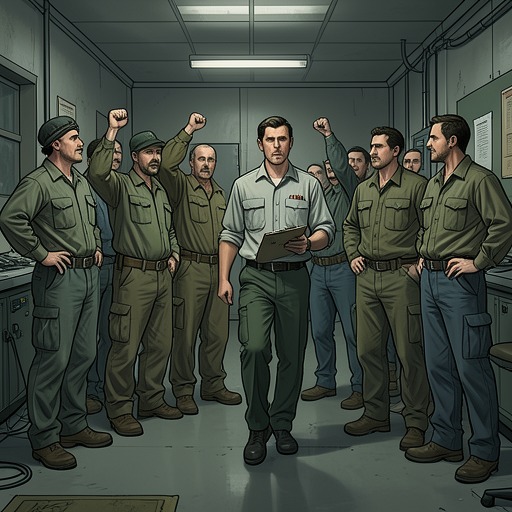
The approach turned abruptly dangerous. Sheeran and his companions walked past a chain-link fence toward a cinder-block building, where about fifty men suddenly emerged. His two companions ran; Sheeran remained and warned the crowd, “I know who you all are. If you go after me you better kill me. If you don’t I’ll be back and I’ll kill you.” Abata made eye contact with him and replied, “We know who you are.” The encounter ended without a reported fight, but the exchange made the threat mutual and personal: both sides understood the identity and reputation of the person facing them.
Sheeran later complained to Glimco that he had been sent into a much larger crowd than he expected. He compared the mistake to being told there was a German squad ahead and encountering a full regiment, then insisted he needed to know how many people he was expected to face next time. The episode exposes the practical uncertainty inside a campaign described as organized pressure: even an assignment framed as a limited warning could put its agent in front of dozens of opponents.
Sabotage and the election result
The campaign also targeted the dissidents’ income. Sheeran describes rebel cabs and cabs displaying Seafarers signs disappearing from stands while their drivers went inside for coffee. The cars were hot-wired, or taken with keys left inside, and driven to Lake Michigan. There, the driver would let the cab roll into the water and sink, preventing its return to service and costing the rebel side revenue.
The account describes an arrangement for getting away after each sinking. A backup car picked up the driver, who handed a police officer a paper bag containing money—sometimes five twenty-dollar bills, Sheeran says. The driver claimed the cab’s brakes had failed or that it had run out of gas; the officer laughed, and the group drove off to look for another target. In Sheeran’s telling, the submerged taxis were not incidental vandalism but an economic tactic in a union-versus-union contest: removing vehicles meant lost income for the dissidents. He explicitly distinguishes the conflict from one with management, describing it as two unions fighting each other.
The tactic did not secure the local. Abata’s rebels won the Chicago election in the summer of 1961. Their victory established that Glimco’s effort to make departure costly had not prevented Local 777 from breaking away. The result also gave Hall’s organization a formal opening to bring the dissidents into its own ranks.
From Local 777 to open union warfare
After Abata took over the rebel cab local, the AFL-CIO held a convention. Hall took the microphone, called Hoffa a “fink,” and gave the rebels a Seafarers charter, making them part of the AFL-CIO. The charter changed the meaning of the Chicago result: the dissidents were no longer merely outside Glimco’s Teamsters local but affiliated with a rival labor organization. Hall’s public insult and formal recognition made the dispute visible as a contest between union powers.
Hoffa responded by declaring open warfare. Sheeran qualifies that account, saying the AFL-CIO had declared the war and that Hall could not have moved in Chicago without the support of the federation’s executive board; Hall himself sat on that board. In Sheeran’s view, the rival organizations were using methods he associated with Hoffa’s own approach, making the taxi dispute a case of fighting fire with fire. This is his interpretation of the larger conflict, rather than a claim that the record establishes every participant’s private motive.
Hoffa later sent Sheeran on assignments in Flint and Kalamazoo, Michigan. Sheeran says he had the feeling that both matters were connected to the Chicago taxis or Hall, and adds that the Seafarers had a hit squad too. The qualification matters: he reports a suspicion, not confirmed details of what those assignments involved. Still, the move beyond Chicago suggests how the local election fed into a wider rivalry. Local 777’s departure had become a precedent, a public rebuke, and a trigger for further confrontations across union territory.